
Soleil Launière ► Creating passages between worlds and reinventing identity
S
ome women become living bridges between realities, cultures, and unseen dimensions. Soleil Launière is one of those women who walks between worlds with sensitivity, strength, and truth.
Born to an Innu father and a Québécois mother and originally from Mashteuiatsh, she carries within her the richness and complexity of this dual heritage. A transdisciplinary artist, she works at the intersection of song, movement, theater, and performance, creating works that open pathways between the visible and the invisible, the intimate and the collective.
Her artistic journey, recognized both in Canada and internationally, reflects a practice deeply rooted in research, creation, and the transmission of knowledge. Through her work, she explores powerful themes such as memory, intergenerational wounds, and possible paths toward healing.
But beyond the artist, Soleil is a woman on her own journey. Her work is intimately connected to her lived experiences, her wounds, her awakenings, and her deep desire to transform what has been wounded into a living source of strength. Through motherhood, she now chooses to pass on something different: pride in her roots, the beauty of her identity, and the transformative power of reconciliation.
Through her presence, her voice, and her art, Soleil Launière embodies a living reconciliation between cultures, between generations, and between parts of the self that were once at odds. She reminds us that by moving through the spaces between our worlds, we can gently find our way back to ourselves and learn once again to stand tall, rooted and free.
Photo credit: Zabell Photo

Alexandra O'Campo ►
Some women dedicate their lives to rebuilding the bonds that unite us to ourselves and to others. Alejandra Ocampo is one of those who deeply believe that love can become a path of awareness, transformation, and reconciliation.
As a relationship therapist and coach, she supports women, men, and couples who wish to learn to love themselves more. Her approach invites each person to reconnect with themselves in order to recognize their needs, embrace their emotions, respect their boundaries, and express them with gentleness and authenticity.
For Alejandra, loving also means accepting vulnerability. Behind the desire to be chosen, welcomed, and understood sometimes lies the fear of being hurt, rejected, or abandoned. This fear can distance us from what we most deeply desire. By creating spaces of listening and compassion, she helps the people she works with to overcome these resistances and rediscover a freer, more conscious, and more authentic way of relating.
She believes that our relationships nourish us, reveal us, and transform us. Even conflicts can become valuable teachers when we choose to welcome them with openness, not seeking to be right, but rather to understand what needs to be heard, acknowledged, or repaired. The other's difference then ceases to be a threat and becomes an invitation to discover a reality different from our own.
Alejandra dreams of a world where we learn to listen to ourselves, to accept ourselves, and to love without losing ourselves. Through her presence, her listening, and her guidance, she embodies a living reconciliation between self and other, between fear and trust, between the need to be loved and the capacity to love with greater awareness. She reminds us that learning to love better is perhaps, quite simply, learning to become a little more human.
Some women dedicate their lives to restoring the connections that bind us to ourselves and to one another. Alejandra Ocampo is one of those women who deeply believes that love can become a path toward awareness, transformation, and reconciliation.
A relationship therapist and coach, she supports women, men, and couples who want to learn how to love themselves and one another more fully. Her approach invites each person to reconnect with themselves, recognize their needs, welcome their emotions, honor their boundaries, and express them with gentleness and authenticity.
For Alejandra, loving also means having the courage to be vulnerable. Behind the desire to be chosen, accepted, and understood often lies the fear of being hurt, rejected, or abandoned. That fear can distance us from the very connection we long for most. By creating spaces rooted in listening and compassion, she helps people move through these barriers and discover a freer, more conscious, and more authentic way of relating to one another.
She believes that our relationships nourish us, reveal us, and transform us. Even conflict can become a powerful teacher when we approach it with openness—not with the need to be right, but with the desire to understand what is asking to be heard, acknowledged, or repaired. The other person’s differences can then cease to feel like a threat and instead become an invitation to discover a reality different from our own.
Alejandra dreams of a world where we learn to truly listen to one another, welcome each other as we are, and love without losing ourselves in the process. Through her presence, her ability to listen, and the work she does with others, she embodies a living reconciliation between self and other, fear and trust, the need to be loved and the ability to love with greater awareness.
She reminds us that learning to love more deeply may simply be another way of learning to become more fully human.

Alice Jerome ► The Guardian of Bonds
Some women devote their lives to restoring the invisible bonds that hold a community together. Alice Jérôme is one of those women who chooses to serve with courage, humility, and perseverance.
Originally from Pikogan, in Anicinabe territory, she has devoted more than forty years of her life to the well-being of her people. Whether through community health, supporting families, social development, or governance, she has always placed people at the heart of her commitment. Her journey reflects an unwavering desire to improve the lives of her community while preserving what lies at the heart of her identity: her culture, her language, and her values.
As the first woman elected Grand Chief of the Algonquin Anishinabeg Nation Tribal Council, Alice Jérôme made history through her inclusive leadership and a vision deeply rooted in solidarity. For her, dialogue remains one of the most powerful forces for transformation. She believes in strengthening relationships between communities, learning to better understand one another, and moving forward together toward a more just and harmonious future.
Her journey is also that of a woman who has experienced the wounds of history. As a child, she lived through the ruptures imposed during the residential school era, an experience that left deep scars on many Indigenous families. Yet rather than allowing those wounds to define her life, she chose to transform them into strength, compassion, and a commitment to future generations.
A poet in her own right, Alice writes to find peace, deepen understanding, and give meaning to what moves through the human heart. Her words, like her actions, carry the same intention: to heal, to pass on knowledge, and to bring people together. Through her love of the Algonquin language, her dedication to her community, and her unwavering belief in the power of a shared dream, she reminds us that reconciliation often begins with a simple gesture: continuing to care for one another.
Through her wisdom, resilience, and ability to build bridges across generations, Alice Jérôme embodies a living reconciliation between memory and the future, between the wounds of the past and the hope of a more united world.

Annick Wylde ► Dancing to heal and protect
Some women remind us that it is always possible to choose another path. Annick Wylde is one of those who have transformed their wounds into strength, their roots into anchors, and their journey into a presence capable of supporting others.
An Anicinabe woman from Pikogan, she grew up between the community and the land, with parents and grandparents who passed on to her much more than just skills. Her father taught her silence, observation, and listening to the forest. Her grandmother instilled in her patience, the gestures, and the wisdom of the land. It was also there that she learned her language, Anicinabemowin, which she still speaks daily.
From a very young age, Annick faced violence, suffering, and deep wounds. Rather than letting these experiences dictate the course of her life, she sought a path back to herself. Traditional ceremonies, the Red Path, and dance gradually became spaces for healing and reconnection. With the Fancy Shawl, she recognized herself in the image of the butterfly emerging from its cocoon and finally opening its wings. Then, the bell dance, this medicine dance she practices today, became both a part of her own healing and a way to carry intentions for others.
But what makes her journey particularly inspiring is perhaps her ability to reconcile seemingly opposing worlds. Annick is also a police officer, a dream she's cherished since the age of ten. In her work, her own path has taught her to look beyond actions, to recognize the wounds that may lie hidden behind behavior, to listen more attentively and judge less. She thus embodies a different way of exercising authority, deeply rooted in human experience and active listening.
Through her way of navigating between tradition and the contemporary world, between protection and compassion, between memory and the future, Annick Wylde embodies a reconciliation that begins within oneself before radiating outward to others. She reminds us that our wounds do not have to choose our destination and that, even when life takes us away from ourselves, there is always a path back to who we truly are.
And sometimes, as she so rightly reminds young people, our dreams know the way before we can even see it.

Aroussen Gros-Louis ► Dancing to honor, transmit, and reconcile
Certaines femmes dansent pour performer. D’autres dansent pour prier, transmettre et faire vivre la mémoire de leur peuple. Aroussen Gros-Louis est de celles qui portent la danse comme un chemin sacré, un langage du cœur et une manière de relier les êtres à leurs racines profondes.
Fière ambassadrice de la Nation huronne-wendat, Aroussen danse depuis l’âge de cinq ans. Très tôt, elle comprend que cet art dépasse le simple mouvement : la danse devient pour elle un espace d’équilibre, d’ancrage et de connexion spirituelle. À travers chacun de ses pas, elle honore les enseignements de ses ancêtres, célèbre la beauté de sa culture et transmet avec générosité les valeurs, la langue et la spiritualité des Premières Nations.
Depuis plus de vingt ans, elle parcourt le monde comme représentante de sa communauté, partageant la richesse de la culture wendat sur des scènes culturelles, lors de cérémonies, d’ateliers et d’événements internationaux. Mais au-delà des performances, Aroussen crée des ponts humains. Elle danse pour rassembler. Elle danse pour envoyer des prières. Elle danse aussi pour ceux qui souffrent, portant dans ses mouvements des intentions de guérison, de lumière et d’amour.
Profondément enracinée dans sa spiritualité, elle choisit en 2014 d’emprunter le Chemin Rouge, une voie de conscience et de reconnexion aux enseignements ancestraux. Chaque journée devient alors un acte de présence, de gratitude et de continuité culturelle. Dans la nature, près de la rivière de Wendake où elle médite quotidiennement, elle retrouve le silence, la mémoire et la force tranquille qui nourrissent son art.
À travers la transmission auprès des jeunes de sa communauté, Aroussen contribue également à raviver la fierté identitaire des nouvelles générations. Elle encourage chacun à ressentir la danse à sa manière, à développer sa propre expression et à honorer ce qu’il est profondément. Car pour elle, transmettre ne signifie pas
imposer : cela signifie ouvrir un espace où chacun peut reconnecter avec son essence.
Par sa présence lumineuse, son authenticité et son engagement culturel, Aroussen Gros-Louis incarne une réconciliation vivante entre les générations, les territoires et les cœurs. Elle nous rappelle que lorsque l’art est porté avec vérité et amour, il devient un acte de guérison collective et une manière puissante de faire rayonner l’humanité.

Audrey-Lise Rock-Hervieux ► The voice that connects generations
Some women reconcile the world by giving a voice back to stories that, for far too long, have been told by others. Audrey-Lise Rock-Hervieux is one of those women who uses words, language, and cultural transmission to bring generations closer together and keep her culture alive.
Known as Maman Autochtone, this Innu woman first turned to writing as a way to express and process her own wounds. Over time, her voice became a space for sharing, allowing her to speak about First Nations realities from within, through their own words, perspectives, and truths.
An author, communicator, and mother, Audrey-Lise now places transmission at the heart of her commitment. She helps keep Innu-aimun alive and thriving, particularly among young people and families. When she represented Quebec in the Senate of Canada, she chose to begin her speech in her own language, making a simple yet powerful statement: “We are still here.” Since August 2026, she has also served on her community council, adding a new dimension to her commitment to her people and to the generations that will follow.
Her journey also tells a more intimate story of reconciliation. By coming to understand the wounds her father carried from the residential school system, she was able to see some of the silences of her childhood differently, move through her anger, and reconnect with a spirituality that feels true to who she is, without having to deny any part of herself.
Through her voice, her language, and her commitment to passing on her culture, Audrey-Lise Rock-Hervieux embodies a form of reconciliation that connects the past with the future. She reminds us that keeping a culture alive also means giving a new generation the opportunity to grow up knowing where they come from, proud of their roots and free to tell their own story.

Chan Tep ► Giving a voice, honoring cultures, and reconciling identities
Some women carry within them stories that transcend borders, hardships, and generations. Chan Tep is one of those who transform exile, resilience, and silences into a living, essential, and profoundly transformative voice.
Born in Cambodia at the end of a period marked by war and genocide, she arrived in Canada as a baby, carried by the courage of her refugee parents. Growing up in Quebec, she faced racism and a lack of representation, developing very early on a keen awareness of the importance of seeing herself and being seen.
A major turning point came at the age of 25 when she battled a serious cancer. This ordeal became a wake-up call. She then chose to redirect her life to give a voice to those too often silenced and to contribute to a more just and inclusive society.
Journalist, host, producer, and equity, diversity, and inclusion consultant, Chan Tep has established herself as an influential figure in Quebec's media landscape. Through the creation of the program Mosaïque en lumière and her numerous collaborations, she has contributed to changing narratives and representations in French-language media.
Deeply rooted in her heritage, she also works to promote Cambodian and Asian cultures in Quebec. As the founder of Connexion Champa, she creates spaces to celebrate Khmer arts and traditions. Her involvement in events such as the Khmer New Year, the Accès Asie Festival, and initiatives highlighting Cambodia demonstrates her desire to preserve, transmit, and gain recognition for these cultural legacies.
Through her journey, her voice, and her commitment, Chan Tep embodies a living reconciliation: between cultures, between identities, between immigration histories and host societies. She reminds us that when cultures are seen, heard, and celebrated, they become powerful bridges to a more conscious, inclusive, and deeply connected humanity.

Chantal Lacroix ► The art of revealing the best in humanity
Some women use their success as a platform. Others choose to use their platform as a movement. Chantal Lacroix is one of those who have managed to do both.
A host, producer, entrepreneur, and compassionate woman, she has held a prominent place in Quebec's media landscape for several decades. But beyond her remarkable career, it is her profound belief in the human capacity to rise again, to help one another, and to transform that distinguishes her journey.
With Pay It Forward , Chantal Lacroix helped create much more than just a television program. She contributed to the emergence of a genuine movement of solidarity that touched thousands of Quebecers. By highlighting stories of generosity, resilience, and mutual support, she reminded us that behind every hardship, there is often a community ready to lend a hand. Week after week, the program inspired concrete acts of compassion and demonstrated that mutual support has an extraordinary transformative power, both for the giver and the receiver.
Through her numerous productions, including On efface et on recommence (Wipe It Clean and Start Over ), she also sensitively explored the themes of change, courage, and rebuilding. Her projects often highlighted people who choose to take control of their lives, overcome their wounds, and open a new chapter in their story. These narratives allowed many viewers to see themselves reflected in these stories, regain hope, and believe in their own capacity for transformation.
Over the years, Chantal Lacroix has become a true champion of humanity. Through media appearances, conferences, events, and the projects she leads, she continues to encourage people to cultivate greater kindness toward themselves and others. Her unwavering commitment to collective well-being reflects a deep conviction: when we choose to support one another, we become capable of creating changes that extend far beyond our own lives.
Through her vision, generosity, and ability to bring out the best in humanity, Chantal Lacroix has been helping people for years to reconnect with their own agency, with hope, and with the strength of human connection. She reminds us that every act of kindness can be the starting point for a transformation far greater than ourselves.

Chantale Niquay ► Passing on culture to keep it alive
Some women transform their story into a pathway for those who come after them. Chantale Niquay is one of those women who has chosen to reclaim her roots so she can pass them on to future generations.
Atikamekw and Innu, a young kokom, cultural educator, and speaker, Chantale is part of one of the last generations to have attended the former residential school in Mashteuiatsh. Her family history also carries the lasting impacts of that system. It took a profound journey of healing for her to understand that we can survive our history, but more importantly, we can choose to transform it.
Over the years, she found in beadwork, traditions, teachings, her language, and the values of her culture different paths leading her back to herself. What had once been weakened became a source of strength and pride, and a living legacy she now wishes to pass on to the generations that follow.
Through her talks, Chantale creates spaces for dialogue where she addresses the legacy of residential schools, their intergenerational impacts, cultural reclamation, resilience, and healing. She does not share her story to remain anchored in the wounds of the past, but to foster greater understanding between peoples and remind us that other paths are possible.
Through her voice, her gentle presence, and her commitment to passing on her culture, Chantale Niquay embodies a form of reconciliation rooted in reclaiming identity and cultural transmission. She reminds us that reconnecting with what is deeply ours can become an act of healing, but also a way of giving future generations the freedom to move forward grounded in their roots, their culture, and their pride.

Colette Normandeau ► Supporting people to transform the world
Some women devote their journey to bringing forth what is most conscious, authentic, and deeply human within each of us. Colette Normandeau is one of those women who profoundly believes that meaningful transformation begins within.
An international NLP Master Trainer, executive and business coach, facilitator, and entrepreneur, she has spent more than twenty years guiding leaders, teams, and organizations in their growth and development. As the founder of L’Essentiel – International School of Humanistic NLP, she has trained and supported thousands of people in Quebec and around the world.
Throughout her journey, Colette has chosen to go beyond tools and models to explore what truly drives the human experience. A leading voice in the movement toward fourth-generation NLP, she explores consciousness, spiritual intelligence, and a form of leadership increasingly guided by the heart. Her international collaborations, including her work with Robert Dilts, reflect this same desire to evolve the way we lead, communicate, and connect with one another.
What she seeks to cultivate is profoundly human: greater authenticity, creativity, awareness, trust, unity, and love. For Colette, transforming organizations and societies begins with individuals who are able to know themselves more deeply, understand one another more fully, and build more conscious relationships.
Through her teaching and commitment, Colette Normandeau helps reconcile people with themselves and with one another. She reminds us that true leadership is measured not only by what we accomplish, but also by the consciousness and humanity we bring to the way we move forward.

Corinne Toka-Devilliers ► Bringing the ancestors home
Some women restore bonds that history once believed it could sever. Corinne Toka-Devilliers is one of those women who devotes her strength to restoring identity, dignity, and a rightful place to those who were once subjected to erasure.
A Kali’na woman from French Guiana, deeply rooted in her language, culture, and the traditions passed down by her grandparents, Corinne maintains a living connection with her ancestors. It is this connection that led her to undertake an extraordinary mission: tracing the Kali’na people who were exhibited in so-called “human zoos” in France at the end of the 19th century and helping make it possible for those who died there to one day return to their homeland.
Using photographs preserved in French archives, Corinne and her team succeeded in restoring the names of 27 of the 33 people exhibited in Paris in 1892. Behind the numbers, faces, stories, and families began to reappear. But for Corinne, recovering their identities was not enough. Their remains also needed to be located so they could return home and receive the funeral rites they had been denied.
What followed was a long process involving customary chiefs, shamans, museums, and French institutions. For years, Corinne carried this mission forward with remarkable determination, helping advance the framework that could make the return of these ancestors possible. It is a profoundly human mission, guided by one simple conviction: they must be able to come home.
What is especially moving about Corinne’s journey is that she speaks neither of revenge nor of guilt. She speaks of dignity, peace, and the future.
Through her commitment, Corinne Toka-Devilliers transforms a painful memory into an act of restoration and unity. She reminds us that while we cannot rewrite the past, we can choose what we do with its legacy and, together, decide what we want to build for the generations to come.

Dominique Anglade ► Opening paths to help others stand tall
Some women break through barriers, then choose to use the path they have traveled to open doors for others. Dominique Anglade is one of those women who puts her leadership at the service of a deeply human conviction: when we have the opportunity to act, we also have the power to create the conditions that allow others to stand tall.
Born in Montreal to Haitian parents who were political exiles, Dominique grew up between different realities, including three years spent living in Haiti. This connection to her roots, combined with the values of social justice passed down by her parents, profoundly shaped her understanding of leadership and our responsibility toward others.
An engineer by training, businesswoman, executive, and politician, she has often been the first to walk through certain doors. The first woman of Haitian descent elected to Quebec’s National Assembly and the first person of Haitian descent to hold a ministerial position in Canada, she would later become Deputy Premier of Quebec and Leader of the Official Opposition. Today, her journey continues in academia, notably at HEC Montréal.
But another achievement may reveal even more about the woman behind the remarkable career. In 2010, Dominique Anglade co-founded the KANPE Foundation with her childhood friend Régine Chassagne. Their vision was not simply to help Haiti, but to support rural communities on their path toward greater autonomy by investing in locally rooted solutions, particularly in leadership, entrepreneurship, education, health, and infrastructure.
This mission became deeply personal when the 2010 earthquake claimed the lives of Dominique’s parents, as well as her uncle and cousin. Yet even in the midst of such profound loss, her commitment to Haiti did not disappear. It continued and was transformed into action. More than fifteen years after KANPE was founded, Dominique remains actively involved with the foundation and, in 2026, once again took on the role of Chair of its U.S. Board of Directors.
Through her journey, Dominique Anglade reminds us that leadership can be far more than a position or a title. It can become a way of building bridges, opening possibilities, and empowering others to shape their own future. A way of ensuring that our individual achievements contribute to something greater than ourselves: helping other people, other women, and entire communities stand tall.

Dr. Eléonore Djikeussi ► Reconciling science, nutrition and healthcare
Some women are transforming the way we care for people by daring to build bridges between approaches that have long been viewed as separate. Dr. Éléonore Djikeussi is one of those women who brings a perspective on health that is at once scientific, integrative, and deeply human.
Trained as an oncologist and an expert in cellular nutrition, she is particularly interested in the role of nutrition, micronutrients, and cellular function in supporting health. Her approach has also led her to explore mitochondrial dysfunction and its role in understanding certain chronic diseases and cancer.
Through her medical practice, books, and educational programs for both healthcare professionals and the general public, Dr. Djikeussi is also deeply committed to sharing knowledge. She makes complex information more accessible, encouraging a broader vision of health in which different dimensions can be considered and brought into dialogue.
Through her work, Dr. Éléonore Djikeussi helps bridge science and integrative approaches, medical expertise and nutrition, knowledge and education. She invites us to broaden the way we think about health and to envision an approach to care in which each person can take a more active and informed role in understanding their own health journey.

Elima Diabong ► Giving a voice, building connections, and transforming silences
Some women transform their silences into powerful words and their wounds into paths of light. Elima Diabong is one of those who give a voice to the unheard, and who forge connections where there was distance.
Born in the Kaolack region of Senegal, she carries within her a life marked by resilience, courage, and a quest for meaning. From a very young age, confronted with a speech impediment and the stares of others, she retreated into observation and writing. It was in this intimate space that her voice was born—a voice that, over time, would become the bearer of powerful and essential stories.
After studying in Morocco and then France, where she earned a master's degree in French as a second language, she settled in Quebec. A mother of two, she chose to dedicate her life to causes close to her heart, particularly the status of women. Through her novel, Thirteen Years Later, she opens a space for reflection on often-silenced realities, such as forced marriage, violence, and the injustices experienced by many women.
But Elima Diabong is also a woman of action. Co-founder of the organization Liaison des femmes immigrantes de la Chaudière-Appalaches (LFICA), she creates spaces for meeting, sharing, and solidarity. Through concrete, human initiatives, she supports immigrant women in breaking their isolation, reclaiming their power, and establishing themselves in their new reality.
Her commitment, recognized notably by the Waraba Trophy for her social involvement, testifies to her desire to contribute to a more inclusive, more supportive, and profoundly humane society. She reminds us that every gesture, every word, and every connection forged can transform a life.
Through her voice, her writing, and her commitment, Elima Diabong embodies a living reconciliation between cultures, between silences and speech, between life paths and future possibilities. She reminds us that when we dare to tell our stories and connect with others, we participate in building a more just, more conscious, and profoundly united world.

Frances Mowatt ► The Guardian of Words
Some women dedicate their lives to preserving what cannot be replaced. Frances Mowatt is one of those who patiently and devotedly guard a treasure as precious as it is essential: the language of her people.
A member of the Abitibiwinni First Nation, Frances Mowatt has dedicated decades to the transmission of Anishinapemo8in, the Algonquin language. A teacher, translator, and educator, she has devoted her life to keeping alive a language that carries a worldview, a collective memory, and an invaluable cultural heritage. Through her work, she helps preserve much more than words: she protects a way of understanding life, territory, human relationships, and the knowledge passed down from generation to generation.
Discreet and deeply humble, Frances carries out her work far from the spotlight. Yet, her influence is immense. She has contributed to the creation of educational tools, the development of linguistic resources, and the translation of numerous important works. Her exceptional expertise has notably enabled her to translate the Charter of Human Rights and Freedoms as well as the six episodes of the series For You, Flora, thus offering many families the opportunity to hear and experience these stories in their own language.
Her work demands far more than a simple translation. Anishinaabemojin is a rich, evocative language deeply rooted in Anishinaabe culture. Finding the right words requires an intimate understanding of the meaning, values, and realities they convey. Through her knowledge, rigor, and intuition, Frances allows this ancestral language to continue evolving while remaining true to its roots.
At a time when several Indigenous languages are threatened, her commitment represents a concrete act of resistance, revitalization, and hope. Thanks to her, children are still learning their language, researchers can share their work with communities, and contemporary works find their place within the world of Anishinaabemowin.
Holder of an honorary doctorate from the University of Quebec in Abitibi-Témiscamingue, Frances Mowatt remains, above all, a woman dedicated to passing on knowledge. A woman who understands that when a language disappears, a part of the world dies. And that when a language continues to live, an entire people continues to dream, to tell their stories, and to recognize themselves.
Through her unwavering commitment to language, culture, and future generations, Frances Mowatt embodies a living reconciliation between the past and the future. She reminds us that words have the power to preserve memory, nurture identity, and bring people together.

Manon Jeannotte ► Leading the Way
Some women dedicate their lives to bringing together what seemed irreconcilable. Manon Jeannotte is one of those who deeply believe that dialogue can open paths where history has left wounds.
A member of the Gespeg Mi'kmaq Nation, manager, entrepreneur, teacher, and institution builder, she has always placed human relationships at the heart of her commitment. Her journey reflects a deep conviction: lasting transformations arise from encounters, listening, and a sincere desire to better understand one another.
In January 2024, she made history by becoming the first First Nations person and only the second woman to be sworn in as Lieutenant Governor of Quebec. This appointment marked a highly symbolic moment. But for Manon Jeannotte, the importance of this role lies not in the prestige it represents. Rather, she sees it as an opportunity to continue what has always guided her: contributing to reconciliation between peoples.
Prior to this appointment, she had already made her mark as Chief of the Gespeg Mi'kmaq Nation and as co-founder of the First Nations Leadership School at HEC Montréal, a visionary project aimed at supporting the development of Indigenous leadership. Wherever she has gone, she has sought to create spaces where people, cultures, and knowledge can meet with respect.
Her commitment to reconciliation is also deeply personal. Like many Indigenous people of her generation, she had to embark on her own journey of reconnecting with her identity. This journey allowed her to understand that reconciliation is not limited to institutions or governments. It begins within oneself, in the capacity to acknowledge one's history, to embrace one's wounds, and to rediscover pride in one's roots.
Today, she uses her voice and position to encourage encounters between Indigenous and non-Indigenous communities, foster greater mutual understanding, and remind everyone that the future is built together. For her, reconciliation is not an abstract concept. It is a daily endeavor that requires openness, courage, and a genuine willingness to walk side by side.
Through her unifying presence, her humble leadership, and her unwavering faith in the power of dialogue, Manon Jeannotte embodies a living reconciliation between peoples, institutions, and generations. She reminds us that beyond differences, there is always space where human beings can meet and choose to move forward together.

Ginette Forget ► To love what is
Certaines femmes nous rappellent que la transformation ne passe pas toujours par l’action. Parfois, elle commence simplement par une présence plus consciente à soi, à l’autre et à la vie. Ginette Forget est de celles qui nous invitent à revenir à cet espace intérieur où il n’y a plus rien à prouver, seulement à être.
Artiste, auteure et conférencière, elle explore depuis de nombreuses années ce qu’elle nomme l’Art de la Présence. Au cœur de sa démarche se trouve une invitation d’une grande simplicité : habiter pleinement l’ici et maintenant, observer ce qui est, accueillir la vie telle qu’elle se présente et retrouver, derrière nos résistances et nos histoires, un espace de paix et d’amour.
À travers ses livres, ses rencontres et ses enseignements, Ginette propose une autre façon d’entrer en relation avec soi-même. Non pas en cherchant constamment à devenir quelqu’un d’autre, mais en reconnaissant ce qui est déjà là. Pour elle, aimer véritablement signifie aussi apprendre à embrasser la vie sans condition, avec douceur, bienveillance et ouverture.
Son travail nous ramène ainsi à une forme essentielle de réconciliation, celle qui se produit lorsque nous cessons de lutter contre nous-mêmes et contre ce qui est. Ginette Forget nous rappelle que la paix que nous souhaitons voir autour de nous peut d’abord prendre naissance dans notre manière d’habiter l’instant, de nous accueillir et d’aimer.

Isabelle Chapadeau ► Between cultures, a voice that unites
Some women devote their lives to building bridges between realities that still know far too little about one another. Isabelle Chapadeau is one of those women who chooses to transform curiosity into understanding and unfamiliarity into dialogue.
Born to a Québécois father and an Inuk mother who passed away when she was a child, Isabelle grew up in Sept-Îles within an Innu community. Growing up at the intersection of several cultural worlds allowed her to discover the richness of Indigenous peoples while also becoming aware of the many misconceptions that still exist today about the distinct First Nations, Inuit, and Métis cultures.
Driven by a desire to better understand her own roots, she moved to Iqaluit to reconnect with her Inuit culture, community, and language.
Realizing how little many people know about the realities of the North, she chose to use social media as a space to educate, raise awareness, and encourage meaningful conversations. Through videos shared in both French and English, she helps demystify Inuit culture, sheds light on contemporary life in the North, and challenges stereotypes and misconceptions.
As a multidisciplinary artist, Isabelle also carries this heritage forward through beadwork, jewelry making, sealskin work, and other forms of artistic expression.
Today, she continues this work of cultural transmission with authenticity while sharing this precious heritage with her two children. Through her voice, her art, and her commitment, she helps bring people closer together and foster greater understanding between cultures.
She reminds us that reconciliation often begins with something very simple: taking the time to truly get to know one another.

Jennifer O'Bomsawin ► Changing the rules for future generations
Some women refuse to accept things as they are. Jennifer O'Bomsawin is one of those who choose to act, to challenge structures, and to open new paths for future generations.
Born into both the Abenaki and Huron-Wendat nations, Jennifer developed a deep awareness of the realities faced by First Nations people at a young age. From adolescence, she was interested in the issues affecting her community, its history, and its future. A journalist, political scientist, strategist, and leader of the next generation of Indigenous leaders, she has dedicated her career to defending the rights of her people while fostering dialogue with the rest of society.
Her commitment is based on a simple conviction: reconciliation must be accompanied by concrete actions. For her, self-determination depends in particular on economic development, access to education, and the ability of communities to fully participate in decisions that affect them. She believes that First Nations must be able to build their prosperity while remaining guardians of their territories, cultures, and values.
Through her work, leadership, and ability to bring people together, Jennifer O'Bomsawin helps build bridges between Indigenous and non-Indigenous communities. She belongs to a generation that chooses to move forward with confidence, proud of its identity, and resolutely focused on the future.
Through her vision, courage, and determination, Jennifer O'Bomsawin embodies a new generation of leaders who choose collaboration over opposition, action over waiting. She reminds us that lasting change arises when women and men dare to imagine a different future and work together to build it.

Josée Leblanc ► Entrepreneurship to pass on knowledge
Some women build businesses. Others use them to build bridges between generations, cultures, and future possibilities. Josée Shushei Leblanc does both.
A proud member of the Innu First Nation of Uashat mak Mani-Utenam, Josée has devoted more than 25 years to economic, cultural, and social development. Her journey has taken her from communications to community leadership and business management, before founding Atikuss Canada, where she transformed ancestral know-how into a vibrant space for creation, cultural transmission, and economic development.
Through Atikuss, which became the first Indigenous Économusée, she helps keep traditional skills such as moccasin and mukluk making alive while bringing them firmly into the present. Her entrepreneurial journey continues today with MASHKu Manufacture, where tradition, innovation, and manufacturing come together, even in the creation of safety footwear. It is a powerful and tangible demonstration that preserving a culture does not mean freezing it in time, but allowing it to evolve, create jobs, and open new pathways.
Recognized many times for her leadership and impact, Josée also puts her experience at the service of other Indigenous women, notably as a lead mentor. Behind the entrepreneur is a woman deeply committed to passing on knowledge and creating opportunities for those who will follow.
Through her bold vision, Josée Shushei Leblanc embodies economic reconciliation rooted in culture and focused on building the future. She reminds us that when ancestral knowledge meets entrepreneurship, it can become a powerful force for self-determination, pride, and cultural transmission.

Josée Savard ► Experiencing the magic of connections
Some women have a gift for seeing the beauty in what connects us and turning it into a source of creativity. Josée Savard is one of those women who transforms life’s experiences into colors, words, and gestures that bring people closer together.
A painter for more than 30 years and an educator by training, she has long moved between art and teaching. From abstract and figurative work to intuitive painting, she explores creativity with the same curiosity she sought to awaken in her students: to learn, experiment, and discover their own way of seeing the world.
In 2015, adopting a child profoundly transformed her perspective on life and reawakened essential values of openness, kindness, and connection. This experience brought her closer to nature, led her to study herbalism, and, a few years later, inspired her to fulfill a long-held dream by founding her own artisanal soap-making business. Her workshops became spaces for creativity and connection, where hands shape and create, but where people also grow closer to one another.
This story of family bonds and love has now found a new expression in her children’s book, Petite Merveille et le fil magique. Inspired by adoption, the story speaks to children about the bonds that connect us and reminds them that a family can hold many different stories, while still being joined by the same invisible thread: love.
Through painting, teaching, craftsmanship, and words, Josée Savard creates to bring people closer together. She reminds us that reconciliation can also begin in this way: through simple gestures that welcome others, honor our connections, and gently bring us back to what truly matters.

Jolianne Ottawa ► Reconciling care and dignity
Some women change entire systems simply because they first chose not to give up on their own dreams. Jolianne Ottawa is one of those who transform obstacles into opportunities and wounds into levers for change.
Originally from the Atikamekw community of Manawan, Jolianne Ottawa pursued her path with determination despite the challenges she encountered along the way. Convinced of the importance of education and self-improvement, she gradually built an inspiring career in service to her community.
A trained nurse, then a health manager and leader, Jolianne has dedicated her career to improving the well-being of her community. Her journey has led her to the directorship of health services in Manawan, where she is helping to rethink healthcare based on the real needs of its population and a vision deeply rooted in Indigenous values.
Under his leadership, the Masko-Siwin Health Centre became the first Indigenous health institution to concretely implement the principles inspired by Joyce's Principle, in order to offer accessible, safe, and non-discriminatory care. This initiative represents much more than a change in schedule or structure: it embodies a commitment to empowering communities to define the healthcare they need.
But perhaps one of Jolianne's greatest contributions lies in her power to inspire. By returning to university as an adult and discovering the extent of her own potential, she understood how encouragement, mentorship, and representation can transform a life. Today, she carries this message to younger generations: their dreams are legitimate, and their future should never be limited by prejudice or circumstance.
Through her leadership, perseverance, and commitment to greater health equity, Jolianne Ottawa helps communities reconnect with their agency, dignity, and future. She reminds us that sometimes all it takes is for one person to dare to believe in their potential to pave the way for an entire generation.

Joyce Dominique ► Reconciling generations through language
Some women devote their lives to preserving what might otherwise fade with time. Joyce Dominique is one of those women who understands that a language is far more than a means of communication. It is a living memory, a bond between generations, and a unique way of experiencing the world.
Originally from the Innu community of Uashat mak Mani-utenam, Joyce has dedicated more than thirty years to keeping Innu-aimun alive and thriving. A translator, communicator, and passionate advocate for cultural transmission, she has devoted her career to bringing her language into media, radio, communications, cultural events, and institutions. Behind each of her projects lies the same conviction: when a language remains alive, an entire people can continue to tell their own story.
From an early age, she learned to move naturally between Innu and French. Yet it was throughout her professional journey that she came to discover the full richness and depth of her mother tongue. Guided by Elders, whom she considers true living libraries, she embarked on a patient journey of listening, learning, and preservation. Every word gathered becomes a treasure. Every teaching passed on becomes a responsibility to carry forward.
Over the years, her expertise in translation has gained recognition far beyond her community. During the Paris Olympic Games, she contributed to translating the names of sporting disciplines into Innu-aimun. True to her approach, she did not simply invent new words to describe contemporary realities. Instead, she turned to the Elders, traditional stories, and the memory held within the land. There, she discovered that many movements associated today with modern sports had long existed within traditional Innu knowledge and practices. The words were still there, simply waiting to be rediscovered.
For Joyce, reconciliation also happens through language. She believes that pride in Indigenous identity is deeply rooted in the ability to speak, understand, and pass on one’s language. And this journey of reconciliation extends beyond Indigenous communities. It also includes everyone who chooses to learn, listen, and recognize the richness of the languages that have been spoken on these lands for millennia.
Through her unwavering commitment to transmission, memory, and dialogue between generations, Joyce Dominique brings the past and the future into conversation. She reminds us that preserving a language also means preserving a way of seeing and understanding the world, and that every word passed on can become an act of reconciliation.

Karine Millaire ► Making law a path to recognition
Some women transform institutions from within, creating more space for recognition, respect, and justice. Karine Millaire is one of those women who uses law not only as a legal tool, but as a powerful means of transforming relationships between peoples.
A proud member of the Wendat Nation, lawyer, and professor at the Université de Montréal’s Faculty of Law, she devotes her practice and research to Indigenous rights, human rights, governance, and self-determination. Her work contributes to advancing the implementation of the United Nations Declaration on the Rights of Indigenous Peoples, cultural safety, the fight against discrimination and racism, and the recognition of Indigenous legal systems.
Her influence also extends into the classroom, where the people who will shape the future of law are being educated. Karine created the first mandatory course on Indigenous Peoples and law for undergraduate students at a civil law faculty in Quebec, responding to Call to Action No. 28 of the Truth and Reconciliation Commission. It is a meaningful step, because transforming relationships between peoples also requires education, a deeper understanding of history, and a willingness to challenge established ways of thinking.
Her commitment extends well beyond her professional career. She also dedicates her time pro bono to defending the rights and interests of Indigenous Peoples and serves on the board of the Canadian Section of the International Commission of Jurists.
Through her work, Karine Millaire helps build bridges between knowledge systems, legal traditions, institutions, and peoples. She reminds us that reconciliation cannot rest on intentions alone. It also requires transforming structures, recognizing rights, and preparing a new generation capable of imagining and building more just relationships.

Kateri Champagne Jourdain ► Minister of Natural Resources and Forests
Kateri Champagne Jourdain est entrée dans l’histoire le 3 octobre 2022 en devenant la première femme autochtone élue à l’Assemblée nationale du Québec, à titre de députée de Duplessis. Cette élection historique a marqué une étape importante dans la représentation des Premières Nations au sein des institutions québécoises et témoigne d’un parcours jalonné d’engagement, de détermination et de leadership. Depuis son arrivée en politique, elle a notamment occupé les fonctions de ministre de l’Emploi et ministre responsable de la région de la Côte-Nord, de ministre de la Famille, puis de ministre des Ressources naturelles et des Forêts.
Originaire de Uashat mak Mani-utenam, Kateri Champagne Jourdain a toujours placé l’humain, sa communauté et le développement de sa région au cœur de son engagement. Diplômée en communication sociale de l’Université du Québec à Trois-Rivières, elle a amorcé sa carrière au sein de son conseil de bande, où elle a contribué à la création du secteur des affaires publiques et des communications. Cette première expérience lui a permis de développer une expertise en communication, en relations avec les communautés et en gestion de dossiers d’envergure, tout en consolidant son désir de contribuer concrètement au développement de sa communauté.
Son parcours professionnel l’a ensuite menée à la direction des Galeries Montagnaises, premier centre commercial au Canada créé et administré par une communauté autochtone. À cette occasion, elle y a démontré sa capacité à conjuguer développement économique, entrepreneuriat et retombées pour la communauté. Son engagement s’est également étendu au monde des affaires, notamment par sa participation au conseil d’administration du Mouvement Desjardins.
Forte de cette expérience diversifiée, Kateri Champagne Jourdain a également accompagné d’importants projets de développement sur la Côte-Nord. À titre de directrice des relations avec le milieu et des communications pour les projets Mine Arnaud et Apuiat, elle a joué un rôle dans le dialogue entre les promoteurs, les communautés et les différents acteurs régionaux. Ces fonctions lui ont permis de mettre à profit son expertise en relations avec le milieu et sa connaissance fine des réalités nord-côtières.
Son entrée en politique provinciale s’inscrit ainsi dans la continuité d’un engagement profondément ancré dans sa communauté et sa région. Durant son parcours, Kateri Champagne Jourdain incarne une nouvelle génération de leaders qui n’hésitent pas à ouvrir de nouvelles voies. Première femme autochtone à accéder au conseil des ministres, elle contribue à faire évoluer les perspectives, inspire les femmes et les jeunes à prendre leur place et participe activement à la construction de relations fondées sur le respect, le dialogue et la collaboration.
Son parcours illustre qu’au-delà des fonctions occupées, le leadership se construit par la capacité de rassembler, de créer des ponts et de transformer les défis en occasions d’avancer. Par son engagement, Kateri Champagne Jourdain contribue ainsi à faire progresser la réconciliation et à bâtir des liens durables entre les nations, tout en portant une voix forte pour la Côte-Nord et les communautés autochtones.

Keithy Antoine ► Creating spaces and transforming pathways
Some women create spaces where lives can be transformed. Keithy Antoine is one of those women who opens new pathways, brings voices together, and empowers those who are still searching for their place.
Born in Haiti and based in Montreal, she embodies a living bridge between the cultures, identities, and diverse realities that shape Quebec today. A visual artist, host, social entrepreneur, and engaged creator, she has spent more than thirty years bringing greater visibility to stories, talents, and perspectives that have too often remained unseen.
As the founder of Boutique Espace Urbain, she created a vibrant space for creativity, connection, and solidarity in the heart of Plaza St-Hubert for more than a decade. Rooted in collaboration, inclusion, and community engagement, it supported hundreds of entrepreneurs from immigrant backgrounds, particularly women, helping build a creative ecosystem that was bold, supportive, and deeply human.
Behind this achievement, however, lies a profoundly personal journey. Just a few months after launching Boutique Espace Urbain, Keithy’s life changed dramatically. Her partner of 15 years, the father of her children, suffered a stroke and passed away at the age of 42.
What followed was not a quick recovery, but a long journey of reconciliation. For more than ten years, Keithy learned to live with grief, not by trying to forget, but by finding a new way to carry the absence. For her, reconciling with life meant honoring the joyful memories they had created together as a family while continuing to move forward.
She chose not to walk that path alone. She leaned into a community, an ecosystem she herself had helped create, and found within it a source of grounding, support, and healing. Along the way, she also redefined what success meant: no longer simply professional achievement, but the ability to move through adversity, remain standing, and continue to love.
Today, she considers this journey one of the accomplishments she is most proud of. Despite the pain, she raised her children in a positive and nurturing environment. With gratitude, she sees in them strength, stability, and an uplifting inner voice. For Keithy, this is what true success looks like.
Over the years, a deep sense of inner peace has gradually taken root. It is a peace born from reconciling with grief, with life, and with herself. Today, she stands on the other side of that experience with an open heart, ready to welcome love into her life once again.
Through her authenticity, courage, and ability to transform challenges into new possibilities, Keithy Antoine embodies a living reconciliation between cultures and identities, but also between loss and renewal, pain and peace.
She reminds us that creating space for others is already a way of helping build a world that is more just, more inclusive, and deeply human.

Louise Portal ► To embody all women and reconcile hearts
Some women move through the arts the way they move through life—with intensity, sensitivity, and a profound search for truth. Louise Portal is one of those women who gives voice to emotions, silences, and the many women who reveal themselves through her.
For more than fifty years, she has been an iconic presence in Quebec’s cultural landscape. A celebrated actress in film, television, and theater, as well as a singer and prolific author, she has touched generations through the authenticity of her performances, the richness of her voice, and the depth of her words. Throughout an exceptional career honored with numerous distinctions, including the Iris Tribute Award for lifetime achievement, she has made a significant contribution to the evolution of Quebec culture and to the sharing of stories that carry meaning.
Beyond the acclaimed artist, however, Louise Portal is a woman in constant exploration. She has been writing since adolescence, seeking to understand and embrace the many facets of her identity. Her books, which she affectionately calls her “purple children,” have become intimate spaces of reflection and transmission, where she explores love, memory, femininity, and the journey toward self-discovery.
Deeply sensitive to the cultures and stories of different peoples, she has also developed meaningful connections with Indigenous cultures, particularly through her roles and immersive experiences. These encounters have shaped her perspective, broadened her understanding, and enriched both her artistic and human journey.
Through her presence, her voice, and her creative work, Louise Portal embodies a living reconciliation of hearts, generations, and the many expressions of the feminine. She reminds us that by daring to embrace every part of who we are—with authenticity and gentleness—we can connect with the essence of our shared humanity and allow it to shine fully.

Manishan Kapesh ► A mother's love at the heart of the circle
Certaines femmes transforment ce qu’on a voulu leur enlever en une force qu’elles choisissent de redonner aux générations suivantes. Manishan Kapesh, aînée innue de Uashat mak Mani-Utenam, est de celles dont le chemin de guérison est devenu un chemin pour tout un peuple.
Survivante des pensionnats, elle a connu très jeune la rupture avec sa langue, sa culture et les enseignements de sa famille. Après des années marquées par les blessures et la consommation, elle fait un choix déterminant : retrouver ses racines et renouer avec les pratiques qui avaient autrefois soutenu son peuple. Ce retour vers elle-même devient rapidement beaucoup plus grand qu’une démarche personnelle. Elle comprend que se reconstruire, c’est aussi préserver ce qui pourra être transmis.
En 2002, elle fonde Kutikuniu, un centre de guérison traditionnelle où elle transmet les cérémonies, les cercles de parole, l’usage des plantes médicinales et les enseignements reliés au territoire et à la roue de médecine. Ce qu’elle a d’abord dû pratiquer dans la discrétion, parfois malgré les critiques et la peur, accueille aujourd’hui plusieurs générations. Des milliers de personnes y sont venues chercher un espace pour retrouver leur dignité, leur identité et une partie d’elles-mêmes.
Au cœur de ses enseignements se trouve une conviction simple et profonde : tout est relié. L’être humain à la Terre, les générations entre elles, la santé physique aux dimensions émotionnelle, mentale et spirituelle. Là où la colonisation a créé des ruptures, Manishan travaille depuis plus de quarante ans à refaire le cercle.
Mais sa plus grande médecine est peut-être sa manière d’accueillir. Peu importe l’âge, l’histoire ou l’origine de la personne qui vient vers elle, Manishan ouvre son cercle avec cette présence profondément maternelle qui lui vaut d’appeler ceux et celles qu’elle accompagne « ses enfants ».
Par sa résilience, sa transmission et cet amour qui ne demande pas d’où l’on vient avant de nous faire une place, Manishan Kapesh incarne une réconciliation qui reconstruit ce qui a été brisé sans jamais oublier ce qui doit être transmis. Elle nous rappelle qu’en retrouvant le cercle, nous pouvons retrouver notre place, les uns auprès des autres.

Raniah (Lynda Thalie)► Crossing borders, uniting worlds and singing of peace
Some women carry entire landscapes within them and choose to turn them into living bridges. Raniah is one of those women who transforms borders into spaces of connection and music into a universal language of reconciliation.
Born in Algeria and now based in Quebec, she first became known as Lynda Thalie. Her journey has been shaped by exile, resilience, and reinvention. From that journey emerged Raniah, a new expression of herself—freer, more grounded, and more deeply aligned with the woman she has become. A voice that no longer seeks only to perform, but to connect, heal, and awaken.
A singer-songwriter, she has spent more than twenty years exploring the sounds of the world, weaving together influences from the Middle East, the Maghreb, and the West. Both intimate and universal, her music creates a space where cultures meet, identities find harmony, and differences become a source of richness. Her warm, embracing voice crosses continents, carrying messages of love, dignity, and unity.
Beyond the stage, Raniah is also a deeply committed woman—a universal mother at heart. Through her humanitarian work, including with refugees in Greece and children in Senegal, she has chosen to place her voice and presence in service of humanity. Her documentary Les Sourires oubliés (The Forgotten Smiles) reflects this desire to touch hearts, raise awareness, and give a voice to those who too often go unheard.
Her journey is that of a woman who dared to transform, to cross her own deserts and allow a strong, luminous, resilient rose to emerge. Through art, service, and the sharing of knowledge and experience, she invites us to broaden our perspective and recognize the beauty of the bonds that connect us.
Through her voice, her presence, and her commitment, Raniah embodies a living reconciliation between cultures, peoples, identities, and life journeys. She reminds us that when we choose to open our hearts and let go of borders—both visible and invisible—we help create a gentler, more conscious, and deeply connected world.
Photo: Christina Pelletier

Mariana Baldé ► Transmitting through art, awakening consciences and making humanity shine
Some women carry within them the living memory of their people. Mariana Baldé is one of those women who passes it on with quiet strength and a deep conviction that the spoken word has the power to reconcile the world.
A speaker and griotte—a keeper of West Africa’s oral tradition—she carries a legacy shared with Indigenous Peoples: one of living transmission and wisdom rooted in storytelling. Born in Conakry, Guinea, and based in Montreal for more than fifteen years, she builds bridges between cultures, continents, and people.
As the founder of Maison des Artistes de la Diversité (MAD), she works to make art a space for transformation. Two of her initiatives embody this vision: La Nuit de la Parole, a storytelling festival that brings together diverse voices each year through the power of oral tradition, and Le Langage des Tissus, an approach that uses textiles from Africa and the Caribbean as mirrors of identity, helping women reconnect with their stories and reclaim their inner strength.
Guided by the Ubuntu philosophy—“I am because we are”—Mariana encourages women to fully embrace their identities and recognize the value of what they carry within them.
Through her voice and her commitment, Mariana Baldé weaves reconciliation where it truly begins: between women, between peoples, and between the stories that connect us.

Marie-Eve Bouchard ► Building the future without forgetting where we come from
Certaines femmes nous rappellent que l’identité ne se résume ni à un statut ni à un document. Elle vit dans les valeurs que nous portons, dans les liens que nous tissons et dans ce que nous choisissons de transmettre. Marie-Ève Bouchard est de celles qui puisent dans leurs racines pour contribuer à bâtir l’avenir.
Pendant une grande partie de sa vie, Marie-Ève n’a pas été officiellement reconnue comme Autochtone. Sa grand-mère avait perdu son statut en épousant un homme non autochtone, entraînant dans son histoire familiale une rupture avec le territoire et une partie de sa culture. Lorsque les changements législatifs lui ont finalement permis de retrouver son statut, une évidence s’est imposée à elle : une identité ne commence pas avec une carte. « J’ai toujours porté ces valeurs-là », confie-t-elle.
Ces valeurs de solidarité, d’entraide, de partage, de respect du territoire et de responsabilité envers la communauté traversent aujourd’hui son engagement professionnel. À Essipit, elle accompagne les entreprises et les entrepreneurs et participe à des projets de développement. Pour elle, développer une économie ne consiste pas seulement à créer de la richesse, mais à construire un milieu où les générations futures pourront continuer de grandir et de s’épanouir avec fierté.
Son parcours transforme ainsi une blessure identitaire en engagement. Là où les lois ont autrefois créé des ruptures et défini qui pouvait ou non être reconnu, Marie-Ève choisit aujourd’hui de contribuer, de rassembler et de faire vivre ce qui n’a jamais véritablement disparu.
Par son leadership, Marie-Ève Bouchard incarne une réconciliation qui relie identité, territoire et développement économique. Elle nous rappelle que les lois peuvent reconnaître une appartenance, mais que ce sont nos valeurs, nos gestes et ce que nous transmettons qui racontent profondément d’où nous venons et ce que nous choisissons de bâtir ensemble.

Marie-Josée Gicali ► Ambassador for Peace between Rwanda and Canada
Some women carry within them a story that reaches far beyond their own lives. Marie-Josée Gicali is one of those women who transforms the scars of the past into pathways of light.
A survivor of the 1994 genocide against the Tutsi in Rwanda, she chose to transform her personal journey into one of purpose and transmission.
After settling in Quebec, she pursued studies in peace education, ultimately earning a doctorate—a profound commitment that reflects her mission: to sow the seeds of peace, here and elsewhere, with awareness and determination.
In both her personal life and her work, Marie-Josée embodies the meeting of worlds. Married to a Québécois man, she is the mother of two children who carry within them the living richness of two cultures. Through them, a bridge is already being built and a dialogue continues across cultures and generations.
Author of On n’oublie jamais rien, she regularly returns to Rwanda to nurture her own healing journey while supporting other survivors on theirs.
Her new documentary project carries this same intention: to create spaces where scars can be acknowledged, soothed, and transformed.
Through her presence, her voice, and her actions, Marie-Josée Gicali embodies a living reconciliation. She weaves connections between peoples, memories, and hearts, reminding us that even in the aftermath of the unimaginable, peace can be born again.

Marjolaine Etienne ► Reconciling women with their power to act
Some women devote their lives to advancing their people while opening doors for the generations that follow. Marjolaine Étienne is one of those women who believes that reconciliation is built through justice, listening, and the full participation of women in shaping the future.
An Innu woman from the Pekuakamiulnuatsh First Nation of Mashteuiatsh, she has worked in service of her community and Indigenous Peoples for more than twenty years. With a background in social sciences and community work, she began her career in community outreach and development before entering politics, driven by a desire to make a meaningful contribution to the well-being of her Nation.
Throughout her career, she has served as a member of the Conseil des Montagnais du Lac-Saint-Jean, as a councilor, and as Vice-Chief responsible for External Relations. Early on, she recognized that Indigenous women remained underrepresented in many decision-making spaces. Convinced that their voices needed to be heard, she created a working group to support and empower elected First Nations women across Quebec and Labrador.
In December 2021, she became President of Quebec Native Women. Since then, she has advocated with determination for the rights, safety, dignity, and well-being of Indigenous women and girls. In May 2024, she organized the Grand Summit to encourage greater representation of women in decision-making bodies and to create spaces where they can fully exercise their leadership.
Her expertise and commitment have also brought her to the international stage. Appointed by United Nations Secretary-General António Guterres to the United Nations Voluntary Fund for Indigenous Peoples, she contributes to bringing the realities and aspirations of Indigenous Peoples to the attention of the international community.
Deeply connected to Indigenous languages, cultures, and traditions, Marjolaine believes it is possible to build a more just future without losing what connects us to our roots. She envisions a world where First Nations women can thrive in safety, have their rights fully recognized, and participate in society on an equal footing.
Through her inclusive leadership, her commitment to women, and her unwavering desire to build bridges between peoples, Marjolaine Étienne contributes to a form of reconciliation rooted in respect, equity, and mutual recognition. She reminds us that when women are empowered to take their rightful place, entire communities rise with them.

Mélanie Vincent ► Creating connections, showcasing cultures, and celebrating encounters
Some women create spaces where hearts can meet. Mélanie Vincent is one of those women who transforms dialogue into a living experience and human connection into a path toward reconciliation.
A member of the Wendat Nation, she has worked alongside First Nations for more than 25 years, guided by a deeply human and committed vision. Through her work in communications and event organization, she has built lasting bridges between peoples, always driven by a sincere desire to foster understanding, respect, and inclusion.
As the founder of the KWE! Meet with Indigenous Peoples Festival, she created a unique space where thousands of people come together each year to discover, experience, and celebrate Indigenous cultures. Beyond the event itself, however, KWE! is an invitation to see things differently—an opening toward more conscious, respectful, and meaningful relationships between Nations.
Driven by a clear commitment to combating racism and discrimination, Mélanie chooses to shine a light on the beauty, richness, and deeply rooted values of Indigenous Peoples.
With her inclusive vision, she strongly believes in the power of images, stories, and media to transform perceptions. As she so thoughtfully expresses, it is essential to show the world the many dimensions of Indigenous Peoples, amplify their voices, and create representations that inspire respect and recognition.
Through her leadership, sensitivity, and remarkable ability to bring people together, Mélanie Vincent embodies reconciliation in action. She reminds us that when we choose to truly see, listen to, and celebrate one another in all our richness, bridges begin to form naturally—and a more united world becomes possible.

Mélanie Paul ► Reconciling the economy through businesswomen
Some women are changing the way business is done. Mélanie Paul is one of those women who demonstrates that human relationships, trust, and reciprocity can become powerful drivers of economic development.
An Ilnu woman from Mashteuiatsh, entrepreneur, speaker, facilitator, and mother, she has dedicated her journey to building connections between peoples, cultures, and different ways of seeing the world. Through conscious leadership deeply rooted in the values of mutual support, sharing, respect, and reciprocity, she is helping redefine the way business relationships can be built and experienced.
Over the years, Mélanie has become a leading voice in Indigenous entrepreneurship, the development of partnerships between Indigenous and non-Indigenous people, and the inclusion of Indigenous workers within Quebec businesses. Known for her ability to bring people and organizations together, she is a true weaver of human connections.
Through her businesses, training programs, retreats, and conferences, she creates spaces where First Nations ancestral knowledge can enter into dialogue with the contemporary world. Her journey, which she describes as a path between her moccasins and her high heels, has shaped a unique approach that brings together cultural identity, leadership, well-being, and economic development.
This vision comes to life through Alliées au féminin, an initiative developed in collaboration with the Réseau des Femmes d’affaires du Québec and the MAIA platform. Through this innovative project, Indigenous and non-Indigenous businesswomen are invited to connect in a different way. Before talking business, they take the time to get to know one another and share their realities, values, and aspirations. The relationship itself becomes the foundation for collaboration.
For Mélanie, economic reconciliation cannot be built through agreements or transactions alone. It grows from trust, listening, and mutual understanding. By creating spaces where women can meet authentically, she helps foster not only new partnerships, but also a new way of doing business.
Her work demonstrates that diversity is not an obstacle to collaboration, but a source of strength that can fuel innovation, creativity, and shared prosperity. By bringing together women from different cultures and backgrounds, she is helping shape an economic model that is more human, inclusive, and sustainable.
Through her commitment to bringing Indigenous and non-Indigenous businesswomen together, her ability to create spaces of trust, and her deeply human vision of economic development, Mélanie Paul is actively advancing economic reconciliation. By fostering alliances, partnerships, and lasting collaborations between women from different cultures, she shows us that it is possible to build an economy rooted in respect, reciprocity, and shared prosperity.

Michèle Audette ► Reconciling peoples through the courage of truth
Certaines femmes consacrent leur vie à bâtir des ponts entre des mondes qui se sont trop longtemps côtoyés sans réellement se comprendre. Michèle Audette est de celles qui ont choisi de faire de la réconciliation une œuvre de vérité, de justice et d'humanité.
Née d'un père québécois et d'une mère innue de la communauté de Uashat mak Mani-Utenam, elle a grandi à la rencontre de deux cultures qui façonnent encore aujourd'hui sa vision du monde. Très jeune, elle comprend que le dialogue, la compréhension mutuelle et le respect sont essentiels pour bâtir une société plus juste et inclusive.
À seulement 27 ans, elle devient présidente de Femmes autochtones du Québec, une organisation fondée notamment par sa mère. Ce premier engagement marque le début d'un parcours exceptionnel consacré à la défense des droits des femmes autochtones et à l'amélioration des relations entre les peuples autochtones et la société canadienne. Elle occupera par la suite des fonctions de plus en plus influentes, notamment à titre de sous-ministre associée à la Condition féminine du Québec et de présidente de l'Association des femmes autochtones du Canada.
Tout au long de sa carrière, Michèle Audette a porté la voix des femmes autochtones dans les espaces où les décisions se prennent. Son engagement l'a menée à participer à la création d'un programme novateur en administration publique autochtone à l'École nationale d'administration publique et à conseiller de nombreuses institutions dans leurs démarches de rapprochement avec les Premières Nations.
En 2016, elle est nommée commissaire à l'Enquête nationale sur les femmes et les filles autochtones disparues et assassinées. Ce rôle marquera profondément son parcours. À travers l'écoute des survivantes, des familles et des communautés, elle contribue à mettre en lumière des réalités trop longtemps ignorées et à faire avancer une conversation essentielle sur la responsabilité collective, la justice et la guérison.
Pour Michèle Audette, la réconciliation ne peut exister sans vérité. Elle exige d'avoir le courage de regarder l'histoire en face, de reconnaître les blessures du passé et de travailler ensemble à transformer les systèmes qui perpétuent encore aujourd'hui les inégalités. Elle croit profondément qu'aucune société ne peut s'épanouir lorsque certains de ses membres demeurent vulnérables ou laissés pour compte.
Aujourd'hui sénatrice du Canada, elle poursuit avec la même détermination son travail de rapprochement entre les peuples. Partout où elle intervient, elle invite au dialogue, à l'écoute et à la responsabilité partagée. Son parcours témoigne d'une conviction profonde : la réconciliation n'est pas un événement, mais un engagement quotidien qui se construit dans les relations humaines, les institutions et les choix que nous faisons collectivement.
Par sa voix courageuse, son leadership rassembleur et son engagement inlassable envers la vérité, la justice et la dignité humaine, Michèle Audette contribue depuis plus de vingt-cinq ans à transformer les relations entre les peuples autochtones et allochtones. Elle nous rappelle que la réconciliation devient possible lorsque nous choisissons non seulement d'entendre l'histoire de l'autre, mais aussi d'en porter ensemble la responsabilité.

Dr. Nathalie Geetha Babouraj ► Reconciling Medicines
Nathalie Geetha Babouraj is one of those women who opens new pathways by weaving connections between science, ancient wisdom, and the intelligence of the living world.
Born in France to Indian parents and deeply shaped by her immersion in India from an early age, she grew up between two cultures, two worldviews, and two approaches to caring for human beings. After becoming a physician, she quickly began to recognize the limitations of an approach focused solely on treating illness. This realization brought her back to her roots and led her to explore practices such as Ayurveda, yoga, meditation, and integrative health.
After practicing medicine, including working with the Paris Fire Brigade, and contributing to international research, she chose to broaden the perspective of conventional medicine and forge a new path. She founded the Tribe Empowered School with a clear vision: to build bridges between modern medical approaches and ancestral wisdom, fostering a more holistic, human, and conscious approach to health.
Through her teachings, sensory journeys, workshops, and books, Nathalie invites us to return to what is essential: to feel, to listen, and to fully inhabit our bodies. She reminds us that health is more than the absence of disease. It is found in the balance between body, heart, and mind, and in our connection with our environment and the living world around us.
She is also the creator of a program that brings us into conversation with people who are reimagining what it means to care. Physicians, nurses, therapists, activists, caregivers, educators, founders of community spaces, and citizens all share a common desire to care for life in its many forms.
Through her journey, her vision, and her commitment, Nathalie Geetha Babouraj embodies a living reconciliation between different approaches to medicine, between cultures, and between modernity and tradition. She shows us that by bringing these worlds together rather than setting them against one another, we can help shape a medicine of the future that is more balanced, more compassionate, and deeply aligned with human nature.

Nathalie Lord ► Singing to spread love
Some women do not need to speak of love for us to feel it. It simply radiates from them—in their presence, their eyes, their voice. Nathalie Lord is one of those women who seems directly connected to a source of unconditional love and chooses to share it with the world through music.
Music has been part of her life since childhood. At the age of six, she began performing on stage with her mother, and a few years later, her brother René introduced her to the guitar and songwriting. Little by little, music became her language—a way of giving words and melodies to what lived within her heart.
Her journey is also the story of a woman who dared to believe in her dreams. From her first television appearances to sharing the stage with her husband, Patrick Norman, Nathalie has continued to follow what called to her most deeply. She has recorded her own albums, including La lumière de l’amour, and in 2022 received the Female Performer of the Year award at the Gala Country of the Festival western de Saint-Tite. Dreams turned into reality, each one a reminder of what can happen when we keep listening to that quiet inner voice telling us not to give up.
But beyond the artist and her accomplishments, what matters most is what Nathalie gives to others. She sings the way she loves—with generosity, sensitivity, and without condition. Her voice brings comfort to the heart and soul, while her journey reminds us that our dreams are not meant only to be imagined, but also to be lived.
Through her music and the way she moves through the world, Nathalie Lord radiates love wherever she goes.
She reminds us that when we dare to follow what makes our hearts come alive, we can not only fulfill our own dreams, but also inspire others to believe more deeply in theirs.

Patricia Dubé ► Reconciling head and heart to be fully
Some women invite us to recognize the richness that emerges when science and consciousness move forward together. Patricia Dubé is one of those women who has learned to combine the rigor of the scientific world with emotional intelligence and a deep understanding of self.
A pharmacist by training and a pharmacy owner for thirteen years, Patricia spent much of her career in a world where knowledge, analysis, and precision are essential. But as her journey evolved, another dimension of the human experience increasingly called to her: leadership, and what allows us to build a life that is truly aligned with who we are.
In 2016, she founded Leadership Santé to support healthcare professionals and their teams in developing their leadership. Her vision, however, extends far beyond the professional world. For Patricia, learning to lead begins with learning to know ourselves, listening to what truly moves us, and having the courage to make room for it in our lives. She captures this philosophy in two simple words: Être pleinement — Being Fully Yourself.
This quest eventually led her to bring together her passions for human development, leadership, and discovering the world through the creation of Odyssée Formations, and later through Odyssée Agence. Travel then becomes much more than simply going somewhere new: it becomes an opportunity to shift our perspective, step beyond what is familiar, and sometimes rediscover our own direction.
Through her journey, Patricia Dubé brings together the mind and the heart, science and consciousness. She reminds us that living fully does not mean giving up one part of ourselves in favor of another, but learning to let all of who we are move forward together, so we can create a life that truly reflects who we are and what makes us come alive.

Rebecca Jean ► Singing to bring worlds together
Some women reconcile the world by refusing to choose between the different parts of their identity. Rebecca Jean is one of those women who transforms her multiple identities into a space for connection, where cultures, languages, and perspectives can come together rather than stand apart.
Born in Quebec to Haitian parents, Rebecca spent many years navigating between two worlds before realizing that she did not have to choose between them. Today, she affectionately describes herself as “Haïbécoise,” a word that expresses this inner reconciliation between her Haitian roots and her Québécois identity. A singer-songwriter, she now brings French and Creole together through music that seeks, above all, to touch something deeply human, beyond words and borders.
Her artistic journey is also closely intertwined with a path of reconnection with herself. Meditation, yoga, and the exploration of her roots gradually led her away from performance as an end in itself and toward presence, intuition, and a freer form of creativity. As she reconnected with her Haitian heritage, she also chose to approach traditions that are often misunderstood or reduced to stereotypes with curiosity and respect, seeking to better understand the cultural richness from which she comes.
With her Haïbécoise project, Rebecca takes this encounter even further. By bringing Québécois works into Creole and introducing local audiences to the richness of the language, she creates a meaningful dialogue between two cultures she deeply loves.
Through her voice and her music, Rebecca Jean embodies a reconciliation that begins within and then becomes a bridge toward others. She reminds us that our identities do not have to become borders. When we embrace them fully, they can become beautiful places of connection.

Sandrine Masse ► Singing to foster dialogue between cultures
Some women reconcile the world by turning their different identities into a source of creative strength. Sandrine Masse is one of those women who uses music to bring into dialogue the cultures, languages, and lands that shape who she is.
Originally from Wendake, this Wendat-Québécois artist was first trained as a classical violist. Throughout her journey, she has drawn inspiration from folk, alternative rock, and traditional music, developing a distinctive world where different sounds come together freely. In her songs, primarily written in French, she also makes space for the Wendat language, creating a bridge between ancestral heritage and contemporary expression.
This meeting of worlds is especially present in her 2024 album, Là où la terre est, in which Sandrine pays tribute to the lands she belongs to. Her music becomes a way of exploring what connects us to a culture, a language, and the land, while also addressing issues such as identity, loss, Indigenous rights, and our relationship with natural resources.
Recipient of the Karim-Ouellet Award in 2025, Sandrine makes her art much more than a form of personal expression. She uses it to question, transmit, and open conversations. Rather than choosing between her different influences, she allows them to coexist and enrich one another.
Through her voice, her viola, and her compositions, Sandrine Masse embodies a form of reconciliation that does not seek to erase differences, but to let them resonate together. She reminds us that when we fully embrace every dimension of our identity, they can become a language capable of bringing cultures closer and creating new spaces for connection.
PHOTO: Maude Prévost-Longpré

Shína Hope ► Making all voices heard
Some people reconcile the world by creating spaces where everyone can fully exist, without having to choose between the different dimensions of their identity. Shína Hope is one of those people who uses words, art, and the sharing of knowledge as pathways to bring different realities closer together, break down prejudice, and ensure that voices too long marginalized can finally be heard.
A Two-Spirit Ilnu person from Mashteuiatsh, Shína has spent more than fifteen years moving between multiple worlds. A multidisciplinary artist, journalist, educator, and social entrepreneur, they work at the intersection of creativity, media, and community engagement with a shared purpose: to bring ancestral knowledge into dialogue with contemporary realities while fostering cultural pride and a strong sense of identity.
This commitment is reflected both in their media work and artistic practice. As an expert consultant with Radio-Canada OHdio and Résonance, Shína contributes to increasing the visibility of First Nations, Inuit, and Métis content. Through slam, spoken word, poetry, the teuehikan, performance, and storytelling, they also explore identity, Two-Spirit experiences, and 2SLGBTQIA++ realities, using art to create space for experiences and perspectives that have too often been pushed to the margins.
Their commitment also extends to the land and to the transmission of knowledge. Through Centre Kukum, Collectif M, cultural projects, and work with various Indigenous events, Shína brings together well-being, ecology, culture, and community. Their journey reflects a vision in which caring for people cannot be separated from caring for Mother Earth, cultures, and the generations yet to come.
By allowing every part of their identity to coexist rather than placing them in opposition, Shína Hope embodies a deeply contemporary form of reconciliation, one in which every dimension of who we are can find its rightful place. Through their voice and creative work, they help broaden the spaces of representation and remind us that reconciling the world also means creating a society where every person can be seen, heard, and welcomed in the full richness of who they are.

Sophie Reis ► Transforming adversity into empowerment
Some women go through an experience that profoundly changes their lives and choose to turn it into a source of strength for others. Sophie Reis is one of those women who transforms adversity into knowledge, vulnerability into action, and her own experience into tools that can help illuminate the path for thousands of people.
An entrepreneur, communications expert, author, and avid traveler, Sophie has always been driven by a desire to create, connect, and make resources more accessible. After a career spanning more than twenty years in communications, strategic partnerships, and business development, she helped launch La Ruche in Montreal and created BB Jetlag, a platform for traveling parents that later inspired a best-selling book.
In 2020, her life took an unexpected turn when she was diagnosed with an aggressive form of breast cancer. Faced with the unknown, Sophie turned to what comes naturally to her: researching, understanding, bringing people together, and sharing knowledge. From this experience came the platform and book Un cancer en cadeau, a project bringing together the expertise of more than 100 physicians, researchers, and specialists to help people affected by cancer and their loved ones better understand what they are going through and reclaim their own power to act.
Her approach creates an essential bridge between science and the human experience, between professional expertise and the needs of the person receiving a diagnosis. Without minimizing the difficulty of the experience, Sophie chooses to focus on the areas where action remains possible, where people can care for themselves and move through uncertainty with greater awareness and gentleness.
Through her ability to transform what she learns into resources for others, Sophie Reis embodies a form of reconciliation with adversity that is not about denying what happens to us, but about choosing what we can make of it. She reminds us that reclaiming our power sometimes begins with understanding, gaining the right tools, and becoming an active participant in our own journey once again.

Suzanne Charland ► Uniting to move forward
Some women reconcile the world through their ability to build bridges where others might see boundaries. Suzanne Charland is one of those women who chooses connection, listening, and collaboration to bring people, communities, and generations closer together.
A former councillor with the Innu Council of Pessamit, where she served several terms, Suzanne embodies a deeply human approach to leadership, guided by a simple conviction: her community has so much to offer the world around it, just as it can grow through meaningful relationships with others. Rather than placing Indigenous and non-Indigenous realities in opposition, she looks for the places where they can meet and build something together.
For Suzanne, this desire to bring people together takes very concrete forms. A simple conversation at a grocery store about the lack of employees from Pessamit helped spark a much broader dialogue about employment, transportation, and relationships between the community, Baie-Comeau, and various regional partners. This is one of Suzanne’s greatest strengths: seeing everyday situations as opportunities to create momentum and bring people closer together.
But moving forward never means forgetting where we come from. Suzanne places great importance on passing down Innu-aimun, ancestral knowledge, and the relationship with the land. She believes it is possible to remain deeply rooted in one’s culture while staying open to others. Between tradition and development, the Red Road and Catholic faith, the forest and the contemporary world, she does not feel the need to choose one side. Instead, she looks for ways to bring them into dialogue.
Through her inclusive leadership, contagious joy, and ability to make room for everyone around the circle, Suzanne Charland embodies a form of reconciliation built through relationships. She reminds us that we can remain deeply connected to who we are while reaching toward others, and that some of the greatest steps forward can begin simply with the courage to speak, to listen, and to search together for common ground.
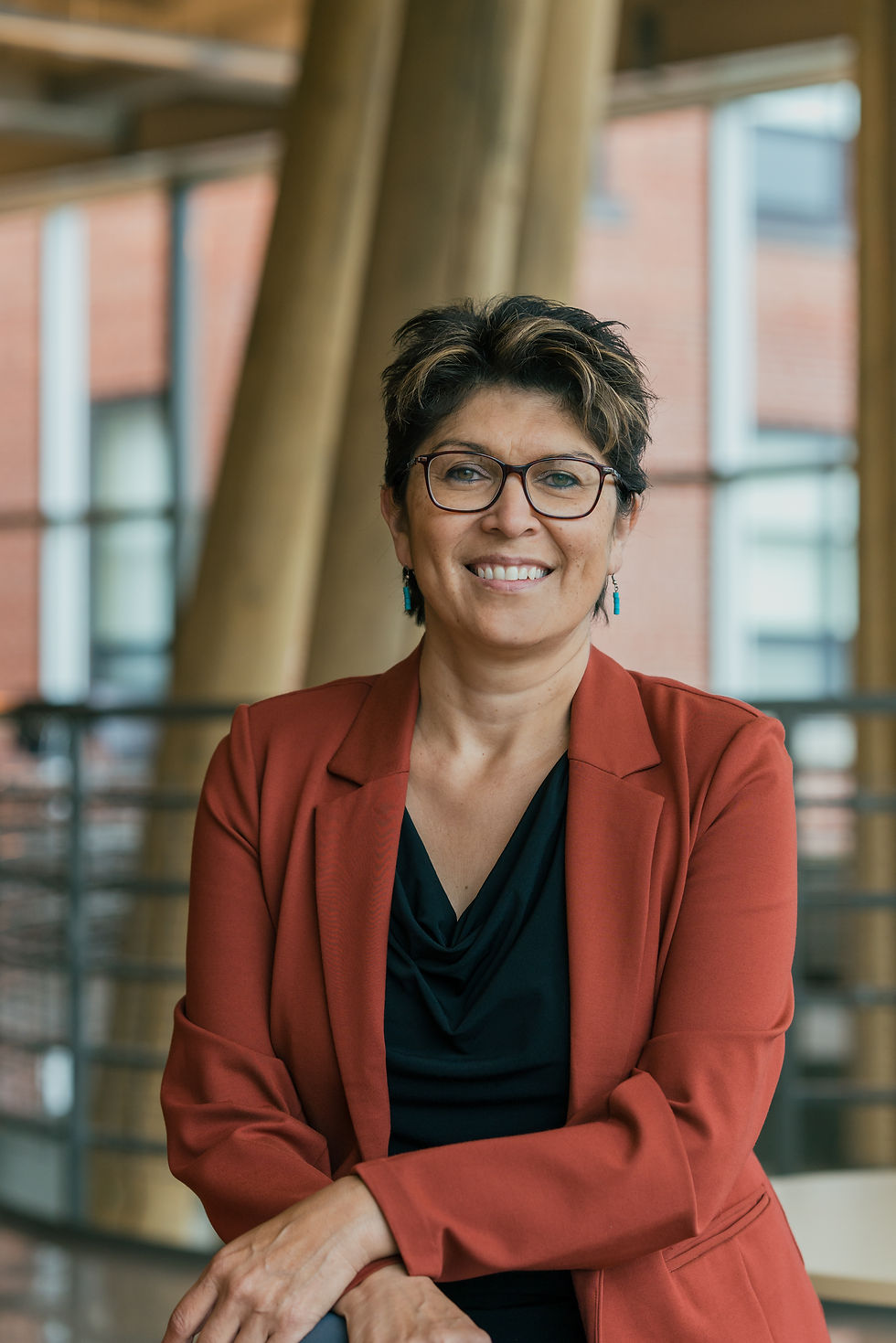
Suzy Basile ► Making truth a path to healing
Some women reconcile the world by having the courage to look directly at what hurts—not to keep wounds alive, but to finally acknowledge them and begin the work of healing. Suzy Basile is one of those women who places the rigor of research at the service of truth, dignity, and women’s voices.
The first Atikamekw woman to earn a doctorate, Suzy began her work as an environmental sciences researcher, exploring the role of Atikamekw women in their relationship with the land and in the transmission of knowledge. But while listening to Elders, she began hearing stories she had never set out to uncover: accounts of childbirth, medical procedures that had not been fully understood, babies who had disappeared, and women who were never able to have children again. These deeply personal testimonies would ultimately lead her work in a new direction.
Suzy later led an extensive research project examining forced sterilizations and obstetric and gynecological violence experienced by First Nations women in Quebec. Across two phases of the study, 132 people agreed to share their experiences, 77 of whom reported having undergone a forced sterilization. Yet behind these numbers, Suzy never lost sight of the faces, the voices, or the immense responsibility that comes with being entrusted with such intimate and painful stories.
Her work is rooted in one essential conviction: we cannot truly move forward until the truth has been acknowledged. For Suzy, rigorous documentation is therefore more than a scientific endeavor. It is a way of restoring credibility to voices that have been ignored for far too long, allowing survivors to be heard, and helping institutions transform their practices. As she has expressed herself, the first step toward healing is having access to the truth.
Through her courage, her ability to listen, and the rigor of her work, Suzy Basile embodies a form of reconciliation that refuses to bypass painful truths for the sake of moving forward more quickly. She reminds us that truth is not the enemy of reconciliation—it is where reconciliation begins.

Sylvie Petitpas ► Reconciling with one's past to move forward in peace
Some women reconcile the world by reminding us that peace with others often begins with a deeper encounter with ourselves. Sylvie Petitpas is one of those women who invites us to look at our own story with greater awareness, compassion, and humanity, so that we can transform what lives within us rather than continue to be shaped by it unconsciously.
A graduate of Université Laval in literature and linguistics, Sylvie began her career in research, communications, and management. Always fascinated by the complexity of human nature, she chose, at the turn of the millennium, to redirect her professional life toward helping others and coaching. Through her own personal journey and extensive training, she developed an approach that brings together self-awareness, psychology, consciousness, and various energy-based practices.
For many years, she has guided people seeking to better understand the recurring patterns, beliefs, and memories that can unconsciously influence their choices. Her work has also led her to support executives and people in positions of influence, helping them reconnect with their center so they can make more conscious and aligned decisions.
An author, speaker, and creator, Sylvie has shared her approach through books, columns, workshops, and psychology-based card decks. Her gift with words allows her to make profound reflections accessible and to create spaces where people can see their own stories from a different perspective.
It is precisely this ability to transform self-knowledge into a pathway toward peace that makes Sylvie Petitpas a natural choice among the 100 Women Reconciling the World. She reminds us that reconciliation does not mean erasing what we have lived through, but learning to see it differently, embracing what it has to teach us, and moving forward with greater awareness. Because when we stop fighting against our own story, something within us begins to soften. And the peace we cultivate within can then become a new way of relating to the world.

Tina Vassiliou ► Building bridges to move forward together
Some women choose to build relationships that allow differences to meet and become a source of strength for moving forward together. Tina Vassiliou is one of those women who creates spaces where cultures, knowledge, and communities can come into dialogue, deepen mutual understanding, and open the door to new possibilities.
In the V formation of migrating geese, Tina sees a reflection of the kind of leadership that resonates with her. Sometimes leading, sometimes following in another’s wake, each bird takes its turn and contributes to the collective momentum. She recognizes herself in this way of moving forward with others—stepping into leadership when the moment calls for it, then making space for both movement and leadership to flow.
This meeting of different worlds is also woven into her own story. Of Greek and Innu heritage, born in Matimekush–Lac John and a member of the Uashat mak Mani-utenam community, Tina grew up at the intersection of several cultures and ways of seeing the world. Her professional journey has also unfolded across different environments, including education, management, governance, research, and hands-on community work. For more than 25 years, she has worked by, for, and alongside First Nations, always seeking to better understand how people can work together without erasing what makes each one distinct.
Her journey can be seen as a portage—a path shaped by passages, transitions, encounters, and learning. Over time, her nimuutan—her portage bag—has grown richer with what she observes, learns, and receives from the people and communities she encounters. She draws from it to make sense of what lies before her, share what may be useful, and continue along her path with new understanding. Keeping her head in the books and her feet on the ground is part of the balance she strives to maintain.
Her approach is rooted in listening, curiosity, and an appreciation for what each person brings. She also understands that different ways of seeing, knowing, and doing do not always have to fully align for a meaningful relationship to take shape. In this way, intercultural dialogue and co-creation begin as a way of being with others before becoming a way of working together.
This same perspective guides the causes and communities she chooses to support, including Indigenous people experiencing vulnerability. Whether the focus is education, development, the environment, inclusion, or community well-being, she looks for the connections between issues and seeks to contribute wherever her experience can be of service.
Perhaps this is where the image of a weaver of connections takes on its fullest meaning. Not someone who claims to bridge worlds on her own, but someone who helps create pathways between them—honoring each for what it is and for what they can learn from one another.
It is this way of building relationships that places Tina Vassiliou among the 100 Women Reconciling the World. Her journey reminds us that reconciliation is shaped as much by what we do as by how we choose to reach toward one another.
With kindness, humility, and courage, she continues along her path, attentive to what connects us and to all that becomes possible when we truly meet one another.

Suzanne Woods ► Reconciling Generations
Some women contribute to reconciliation between peoples. Others work toward a quieter, yet equally essential form of reconciliation: the kind that takes place within families, across generations, and within ourselves. Suzanne Woods is one of those women who has devoted her life to this work of healing.
For more than twenty years, she has guided thousands of people through the practice of family constellations, a powerful process that helps bring to light the invisible bonds connecting us to our family history. With gentleness, depth, and respect, she helps people better understand what has been passed down from one generation to the next and how these inherited patterns may continue to influence their lives.
For Suzanne, individual wounds are often connected to larger stories. Behind struggles, conflicts, fears, or recurring patterns may lie unresolved grief, trauma, exclusion, or suffering carried within an entire family system. By restoring each person’s rightful place and dignity, it becomes possible to bring greater balance to the family system, restore connections, and transform our relationship with the past.
Through her work, Suzanne helps people reconcile with their parents, their ancestors, their history, and ultimately, themselves. Her approach is not about erasing what happened, but about learning to see it differently—with greater compassion, understanding, and love.
Over the years, she has become a recognized figure in the field of family constellations. Beyond her expertise, however, it is her ability to create spaces rooted in humanity, non-judgment, and respect that deeply touches and transforms the people she guides.
By helping people heal wounds from the past and restore connections across generations, Suzanne Woods contributes to a form of reconciliation that reaches far beyond the individual. When one person finds peace with their story, an entire family—and sometimes generations—may feel its impact. She reminds us that peace in the world often begins with the peace we cultivate within our own hearts.

Fanny Wylde ► Reconciling peoples through justice
Some women open doors that no one before them has ever walked through. Fanny Wylde is one of those women who has transformed her personal achievements into a path of hope for an entire generation.
Originally from the Anicinabe community of Pikogan in Abitibi, she became the first woman lawyer in the history of the Algonquin Nation in Quebec. This groundbreaking achievement reflects her determination, perseverance, and deep commitment to the well-being of her people.
From a young age, Fanny dreamed of becoming a lawyer. Despite the challenges she encountered along the way, she left her community to pursue legal studies in Montreal, driven by a desire to gain the tools needed to defend the rights and interests of First Nations. In 2007, she was called to the Quebec Bar, making history as the first woman lawyer from the Algonquin Nation in Quebec.
Since the beginning of her career, Fanny Wylde has put her legal expertise at the service of justice and greater recognition of Indigenous realities. Her knowledge and commitment have led her to contribute to major commissions of inquiry addressing issues affecting First Nations, helping ensure that voices too often absent from decision-making spaces are heard.
Her work earned her the Mérite Justice autochtone, an honor recognizing her contribution to advancing law and justice for Indigenous communities. Throughout her career, she has demonstrated that law can be a powerful instrument for transformation, recognition, and stronger relationships between peoples.
For Fanny Wylde, justice is about more than applying the law. It also requires a deeper understanding of First Nations realities, a commitment to equity, and a willingness to help build institutions that are more representative and inclusive.
Through her courage, perseverance, and commitment to her community, Fanny Wylde helps bring peoples closer together and advance reconciliation within legal and institutional spaces. She reminds us that every door opened today creates a new possibility for those who will walk through it tomorrow.

Kerline Joseph ► Building justice and transforming structures
Certaines femmes consacrent leur vie à faire évoluer les structures sociétales, afin que la dignité humaine devienne une réalité pour toutes. Kerline Joseph est de celles qui transforment le droit en levier de justice et l’engagement en force de transformation collective.
Originaire d’Haïti, elle incarne un parcours profondément ancré dans la rigueur, le savoir, et le service. Titulaire d’un doctorat en droit, d’une maîtrise en droit international et d’un baccalauréat en criminologie, elle a choisi très tôt de mettre ses connaissances au service de la promotion et de la protection des droits des femmes, ici comme à l’international. Son engagement l’a menée à œuvrer dans des pays variés, notamment en Afrique, où elle a contribué activement à des avancées majeures en matière de droits humains.
À titre d’adjointe de la Rapporteure spéciale sur les droits des femmes à la Commission africaine des droits de l’Homme et des peuples, elle a participé à la mise en œuvre et à l’adoption d’outils juridiques essentiels pour la protection des femmes à l’échelle du continent.
Au-delà de son parcours académique et institutionnel, Kerline Joseph est une bâtisseuse de ponts et de solutions. En fondant l’organisme Voix Sans Frontières, elle a créé un espace dédié à l’accompagnement des femmes immigrées au Canada, contribuant à la reconnaissance de leurs droits et à leur autonomisation.
À travers ses multiples implications et approches concrètes, elle favorise l’émergence d’un leadership conscient, inclusif et transformateur. Sa vision dépasse les cadres traditionnels. À travers des initiatives comme la méthode Toro Empowerment, elle invite les individus et les collectivités à activer leur force intérieure et à s’engager dans des actions porteuses de sens et d’impact durable. Son implication dans des projets d’envergure, tels que le programme SAGA de l’UNESCO visant l’égalité des genres dans les sciences, témoigne de sa volonté de contribuer à un monde plus équitable, où les femmes occupent pleinement leur place dans tous les domaines. Cette initiative a mené à la création de la première Chaire UNESCO Femmes et Sciences en Haïti.
Son parcours et son engagement ont été honorés par le prestigieux Prix du Gouverneur général du Canada en commémoration de l’affaire « Personne », reconnaissant ainsi son apport précieux à l’avancement des droits des femmes.
Par son intelligence, sa vision et son engagement, Kerline Joseph incarne une réconciliation vivante entre les structures et l’humain, entre les droits et leur application, entre les cultures et les réalités sociales. Elle nous rappelle que lorsque la connaissance se met au service du cœur et du collectif, elle devient un puissant moteur de transformation, de justice et de richesse pour un monde plus conscient, équitable et profondément humain.